Monday, 11 July 2011

Where have all the Orange Roughy gone?

Remember that fish called ‘orange roughy’?  While it was fairly common and popular in the 1980s and 1990s, nowadays it’s almost nowhere to be found in the supermarket.  That’s because…well…we’ve very nearly eaten them all.

As the following graphic shows, the orange roughy arrived with a bang and is now leaving with a long, drawn-out aquatic whimper.  The first sizeable catches were recorded in 1979.  A decade later the world catch peaked at a massive 91,000 tons.  And then, just as quickly, catches plummeted and now they linger around 13,000 tons a year. 

Source: FAO Fish Stat, 1950-2009 Capture Production. 
CLICK HERE for an interactive version.

The problem is that the orange roughy is a deep-sea species that cannot sustain the level of exploitation that our technology and policies have made possible.  It simply reproduces too slowly.  Orange roughy typically don’t start breeding until they’re 30 years old and can live up to 150 years. So catching orange roughy is much more like mining than fishing.  In effect, it’s more like a non-renewable resource!

Some countries and regional fisheries management organizations have passed measures to protect the orange roughy.  In Australia, orange roughy was listed as a threatened species in 2006.  Unfortunately, these measures have tended to be implemented once the population has been reduced to low levels and nearing ‘commercially extinction’ – that is, so rare that fishing it is no longer profitable.

What about the remaining orange roughy fisheries?   

Nearly 100% of the global roughy catch now comes from the Southwest Pacific, mostly caught by New Zealand.  Though some areas have been closed to orange roughy fishing and catch limits and other measures have been implemented, the 2002 - 2006 average catches on the high seas exceeded the estimates of long-term sustainable yields.  Catches continue to decline, and the future is grim as the fisheries have adopted a pattern of ‘serial depletion’, where fishing operations move from one area to another as local stocks crash. Some fisheries are now as low as 3 percent their unfished size.

And then, of course, is the problem of bottom trawling

While New Zealand has closed some areas to bottom trawling, other areas are still open to bottom trawling with virtually no controls. That is contrary to United Nations resolutions adopted in 2006 and 2009, which require specific actions to be taken BEFORE proceeding to fish, including:

  • assessing the ocean floor for potential damage to vulnerable marine ecosystems from bottom trawling,
  • putting into place measures to protect them, 
  • closing areas as necessary, and
  • ‘moving on’ or stopping fishing when vulnerable ecosystems like coral and sponges are encountered.

The New Zealand fishing fleets aren’t required to do any of those things in fully one third of the fishing grounds – the most heavily fished areas.  Unless changes are made and paper commitments become action, it looks like just a matter of time before orange roughy disappear completely from our dinner plates, our supermarkets shelves, and even their own habitat among the ancient corals and sponges of the deep sea floor.


Sources:
  • A. Penney. (2010, June). Overview of Best Available Scientific Information on Orange Roughy Sustainable Catch Limits in the SPRFMO Area. New Zealand Ministry of Fisheries.
  • C. Wallace and B. Weeber. (2003). The Devil and the Deep Sea – Economics, Institutions, and Incentives: The Theory and the New Zealand Quota Management Experience in the Deep Sea. Deep Sea 2003: Conference on the Governance and Management of Deep-sea Fisheries. Part 1: Conference Report.  1-5 December 2003. Queenstown, New Zealand. Available here.

Tuesday, 28 June 2011

Roundnose Grenadier Visits the United Nations

Last week, the Roundnose Grenadier visited the United Nations, where delegates met for the Open-ended Informal Consultative Process on Oceans and the Law of the Sea (ICP). Roundnose had a little trouble getting in the UN, but luckily he made some friends outside who could help guide him. 

Monday, 27 June 2011

The Dangers of Deep Sea Bottom Trawling

Deep-sea bottom trawling is one of the main reasons the coalition came together.  It is the most common type of deep sea fishing - an estimated 80% of the high seas deep-sea catch is taken through bottom trawling.  

And deep-sea bottom trawling is very bad for the marine environment.  It’s so destructive that over 1,000 scientists from around the world signed a petition to ban it back in 2004.

Why is deep-sea bottom trawling so destructive?    Two reasons.

First, you have the gear.  Huge nets with weighted rollers and heavy doors are dragged across the sea floor.  This method grinds away the bottom habitat and indiscriminately catches whatever falls in or leaves it crushed in its wake.   To draw a better picture, one company markets what it calls 'Canyonbusters' - trawl doors that weigh up to five tons each!

Second, deep-sea life is tremendously fragile.  Because of the extreme conditions, ecosystem productivity is very low.  This means that a deep-sea ecosystem will take decades to centuries to recover even from a single trawl sweep. 

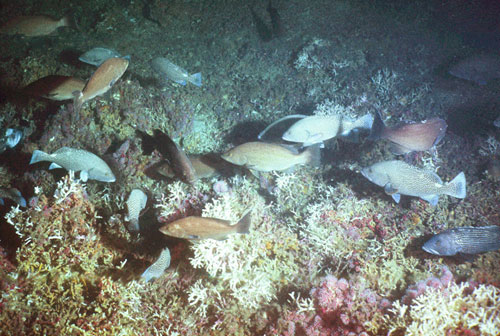
Here’s the deep sea before and after the pass of a bottom trawl net:

Groupers were abundant on deep-sea Oculina coral reefs off Florida's Atlantic Coast before trawling began.
Legal and illegal trawling has nearly eliminated the corals and large fishes in this ecosystem.
Want to know more?  Here’s a great video put together by Greenpeace, one of our coalition members.


Source:

Matthew Gianni (2004). High Seas Bottom Trawl Fisheries and their Impacts on the Biodiversity of Vulnerable Deep-Sea Ecosystems: Options for International Action. Executive Summary. IUCN, Gland, Switzerland.  Available here.

(Images: Deep-sea coral reefs off Florida's Atlantic coast, before and after trawling, Credit: Deep Sea Conservation Coalition.)

Wednesday, 22 June 2011

Not All High Seas MPAs Are Created Equal

A major goal of the marine conservation community is to see that more marine protected areas (MPAs) are established because they have been found to be highly effective to protect ocean ecosystems.  The international community has even gone so far as to include a goal under the Convention on Biological Diversity (CBD) to establish MPAs in 10% of the world’s marine areas by 2020. 

That’s a huge amount of ocean to be protected – 36 million square kilometers.  Unfortunately, the world is not on-track to meet the 2020 goal.  Only 1.31% of the world ocean is covered by MPAs and few are on the high seas because of the legal complexities.

Now we are learning that some high seas MPAs are not very effective.  According to Jeff Ardron, Director of the High Seas Program at the Marine Conservation Institute (MCI) some MPAs have been developed according to science, but other MPAs have been created less systematically—sometimes with the intention of not protecting the most vulnerable areas!  Jeff and his colleagues at MCI are presently studying these inconsistencies in high seas MPAs around the world. 

Watch the video below for Jeff’s take on the problem:


Tuesday, 21 June 2011

This Week: The United Nations ICP Meeting


According to a 2008 analysis published in Science, over 40% of the world's oceans are heavily affected by human activities and few if any areas remain untouched.

The DSCC is back at the United Nations headquarters to advocate for much needed deep-sea conservation measures.  This week marks the 12th meeting of the ‘United Nations Open-ended Informal Consultative Process on Oceans and the Law of the Sea’.  In UN-speak, the annual meeting referred to as ‘UNICPOLOS’ or ‘ICP’.

So why is ICP important?  Well, it’s the principle annual meeting where the UN General Assembly a) reviews developments in ocean affairs, and b) identifies areas where international coordination and cooperation could be improved.  An important element of this meeting is the Report of the Secretary-General that is presented and considered by the General Assembly. (The report is good reading for anyone interested in the latest updates on international marine policy.)

ICP takes on a particular theme each year, and this year that theme is the June 2012 UN Conference on Sustainable Development (or Rio+20), possibly the most influential global environment conference this decade.  The Rio+20 meeting has the potential to bring all 192 member states of the UN together to take decisions how we can sustain the well-being of our planet and ourselves.  The original Rio Earth Summit (or UN Conference on Environment and Development) resulted in (among other things): the Rio Declaration on Environment and Development, the Convention on Biological Diversity, and the Framework Convention on Climate Change.

The challenge, however, is that the focus of Rio+20 has not yet been decided.  As BBC correspondent Richard Black writes, it is a ‘big summit’ in search of a ‘big idea’.  The DSCC and the rest of the ocean community believe that big idea should be the oceans. 

According to the preliminary findings of a major new report, the global ocean is "at high risk of entering a phase of extinction of marine species unprecedented in human history" as a result of overfishing, pollution, and climate change.  International waters – which cover 45% of the planet – are essentially open for managed exploitation.  The main exception is international fisheries.  They are partially managed in some areas of the world, but overall evaluations show them to be failing in their conservation mandates.

The DSCC believes that the time has come for the world to tackle the serious and long-running threats to the marine environment.  This week we will be looking to the ICP to ensure that the oceans are a high priority at next year’s summit.  We will also continue to push our UN goals specific to deep-sea conservation this year.

(Image: A Global Map of Human Impacts to Marine Ecosystems, Credit: National Center for Ecological Analysis and Synthesis.)

Friday, 10 June 2011

The Fish Can Dance!

While on his way to the United Nations, our Roundnose Grenadier stopped in at a 'splash' mob held in honor of World Oceans Day at the Smithsonian's National Museum of Natural History in Washington, DC. Roundnose was happy to see his deep-sea friend, Orange Roughy there. Roughy is tired of the deep sea bottom trawlers messing up her home too so she agreed to help Roundnose do what they can to put a stop to them!

Who knew Roundnose and Roughy could boogie down with the best of them?! Look out Dancing with the Stars, here come your next champions!


Thursday, 9 June 2011

Interview with an Expert: Susanna Fuller on the Implementation of the UN Resolutions

The main challenge to deep-sea conservation on the high seas is the fact that a handful of deep-sea fishing countries is not following the rules. Recently, this fact was further explored by the DSCC in the preliminary findings from its third comprehensive review of the implementation of UN General Assembly resolutions calling for protection of the deep sea. (The full report is forthcoming.)

Recently, the DSCC was able to discuss this problem with Susanna Fuller, the Marine Conservation Coordinator at the Ecology Action Centre in Halifax, Nova Scotia.


Among the topics discussed are:
  • Partial implementation of UN resolutions by the Northwest Atlantic Fisheries Organization (NAFO) [0:31]
  • The behavior of countries' fleets on the high seas and, in particular, their inconsistency in implementing their obligations across different ocean regions [2:52]
  • Preparing for the UN's review of the implementation of its resolutions in September this year [4:11]